Public vs. Private Blockchain: Key Differences, Security, Use Cases, and How to Choose

Public vs. private blockchain: The short answer
A public blockchain is open to anyone who wants to participate under the network’s rules. A private blockchain restricts participation to approved users or organizations. Public networks prioritize openness, neutral verification, and trust minimization. Private networks prioritize identity, privacy, predictable operations, and controlled governance.
The best choice depends on the trust model and business requirements. Use a public blockchain when participants need open access and independent verification. Consider a private or consortium blockchain when known organizations need a shared, auditable record with restricted visibility. Before choosing either model, confirm that a blockchain is necessary at all.
Should you use a blockchain at all?
A blockchain is not automatically better than a conventional database. Start with the underlying coordination problem.
A blockchain may be justified when multiple independent parties need to maintain a synchronized record, no single participant should be the sole source of truth, the record must be independently auditable, and the participants need a shared process for validating updates.
A conventional database may be the better choice when one accountable organization can operate the system, participants already accept that organization’s authority, the workload is highly centralized, or the added governance and operational complexity of a distributed ledger provides no measurable benefit.
Use this precondition test before comparing public and private designs:
| Question | If the answer is “yes” | If the answer is “no” |
|---|---|---|
| Do multiple organizations need a shared record? | Continue evaluating a shared ledger. | A conventional database may be sufficient. |
| Do those organizations need independent verification? | Compare public, consortium, or hybrid models. | A trusted system owner may be enough. |
| Is there a meaningful dispute or reconciliation problem? | Evaluate whether a common transaction history would reduce it. | Blockchain may add complexity without solving a material problem. |
| Must the record be tamperevident over time? | Compare blockchain immutability with signed logs, append-only storage, or database controls. | Standard database controls may be adequate. |
| Can the participants agree on governance, identity, and recovery? | Proceed to architecture selection. | Resolve operating-model questions first. |
The objective is not to deploy a blockchain because it is fashionable. The objective is to choose the simplest architecture that satisfies the trust, auditability, privacy, and coordination requirements.
The four blockchain network models
“Public” and “private” describe broad access and ownership patterns, but they do not describe every possible design. The following taxonomy prevents common terminology mistakes.
| Model | Who can participate? | Who governs it? | Typical visibility | Common fit |
|---|---|---|---|---|
| Public / permissionless | Anyone who follows the protocol rules | A distributed community, protocol process, or foundationsupported ecosystem | Broadly visible by default, subject to the network’s privacy features | Open digital assets, decentralized applications, public verification, global networks |
| Private / permissioned | Approved participants | One organization or a controlled operator | Restricted by role, membership, channel, or data policy | Internal workflows, controlled enterprise records, regulated operations |
| Consortium / federated | Approved participants from multiple organizations | A selected group governed by an agreement | Shared selectively among participating organizations | Supply chains, trade finance, interbank workflows, multiparty settlement |
| Hybrid / permissionedpublic | Different rules apply to different layers or functions | Split between private operators and public protocols | Sensitive data remains restricted while proofs or commitments may be public | Public verification of private records, tokenization, selective disclosure, interoperability |
A permissioned blockchain is defined by access and action controls. A private network is usually permissioned, but a consortium network can also be permissioned while distributing governance across several organizations. “Private” therefore describes the network’s restricted environment, while “permissioned” describes who may join, validate, view, or perform specific actions.
What is a public blockchain?
A public blockchain is an open, permissionless distributed ledger. Users can generally read the ledger, submit transactions, and interact with applications without receiving approval from a central administrator. Bitcoin and Ethereum are well-known examples.
A blockchain stores records in blocks that are cryptographically linked to earlier blocks. Network nodes maintain and verify a shared state, while a consensus mechanism helps participants agree on accepted transactions. Ethereum’s official documentation describes a blockchain as a database shared across many computers and explains how cryptographic references connect blocks into a chain. 1
Main characteristics of public blockchains
- Open participation: Users do not need membership approval to access the network.
- Distributed control: Validation and governance are spread across a broad participant base rather than assigned to one operator.
- Public verifiability: Activity can generally be inspected and independently verified.
- Economic security: Many networks use fees, staking, or other incentives to discourage dishonest behavior.
- Censorship resistance: No single operator should be able to block valid activity easily.
- Composability: Developers can build applications that interact with shared public infrastructure.
- Network effects: Users and developers can participate globally without negotiating access with every other participant.
Common public blockchain examples
Bitcoin, Ethereum, Solana, and Avalanche are examples of major public Layer 1 networks. Their consensus mechanisms, execution environments, scaling systems, and privacy features differ. “Public blockchain” should therefore not be treated as a guarantee of a particular throughput, fee level, or privacy outcome.
What is a private blockchain?
A private blockchain is an access-restricted distributed ledger. An organization or consortium defines membership, validates identities, assigns permissions, and manages governance.
In a permissioned network, participants are known or identifiable. That makes it possible to use business agreements, organizational policies, and regulatory controls as part of the trust model. Hyperledger Fabric, for example, is designed as an enterprise-grade permissioned platform and supports confidentiality through channels and private-data features. 2
Main characteristics of private blockchains
- Controlled membership: Only approved participants can join or perform specific actions.
- Known identities: Organizations can associate transactions with verified members or roles.
- Selective visibility: Data can be limited to participants who need it.
- Defined governance: A company or consortium can manage upgrades, permissions, disputes, and operating rules.
- Predictable operations: A restricted validator set may support more predictable latency and throughput for a defined workload, but performance still depends on the protocol and implementation.
- Enterprise integration: Permissioned networks can be designed around existing identity, compliance, key-management, and operational systems.
- No required cryptocurrency: Some permissioned systems can operate without a native token, although digital assets remain possible when the use case requires them.
Common private blockchain platforms
Examples include Hyperledger Fabric, R3 Corda, and private or consortium deployments based on Ethereum-compatible technology. Platform selection should follow the use case, governance model, privacy requirements, integration plan, and operating capabilities rather than brand recognition alone.
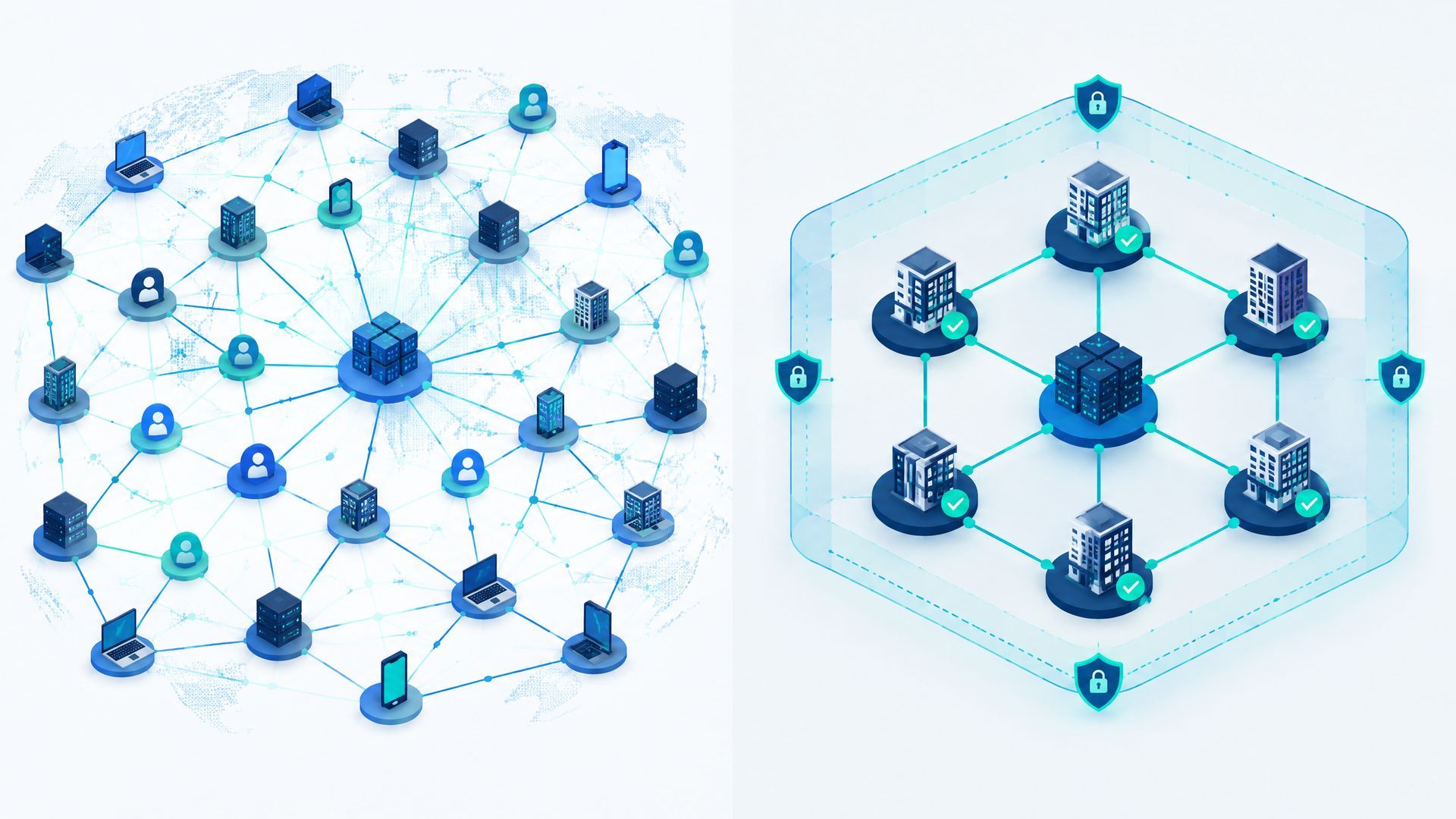
Public vs. private blockchain: Side-by-side comparison
| Factor | Public blockchain | Private blockchain | Consortium or hybrid implication |
|---|---|---|---|
| Access | Open to anyone subject to protocol rules | Restricted to approved participants | Restricted membership with multiple organizations or different rules by layer |
| Identity | Often pseudonymous or user-controlled | Known, verified, or organization-managed | Usually verified across participating organizations |
| Control | Distributed across a broad network | Managed by one organization or operator | Shared among selected members or split between private and public layers |
| Ledger visibility | Broadly visible by default | Selective or role-based | Shared only with relevant members; public proofs may reveal limited information |
| Consensus | Open-participation mechanisms such as Proof of Stake or Proof of Work | Restricted validators using a configured consensus model | Governance and fault assumptions must be agreed among members |
| Performance | May experience congestion, variable latency, or changing fees | Can be more predictable for a defined deployment | Depends on topology, workload, interoperability, and the slowest required participant |
| Security model | Cryptography, economic incentives, and a broad validator set | Access controls, identity, governance, and trusted operators | Requires both technical controls and enforceable multiparty governance |
| Privacy | Transactions are often public by default; privacy layers may be added | Data can be restricted by role, channel, or collection | Sensitive records can remain private while a commitment is made public |
| Transaction costs | Users commonly pay network fees | Infrastructure costs are generally borne by the operator or members | Costs include shared operations, governance, integration, and possible public anchoring fees |
| Immutability | History is difficult to rewrite without broad network agreement | Records may be durable, but authorized administrators can have more intervention power | Define who can correct, reverse, or dispute a record and how that action is audited |
| Governance | Community- or protocol-driven and often slower to coordinate | Organization-driven and often easier to coordinate | Requires voting rights, admission rules, upgrade procedures, and dispute resolution |
| Regulatory alignment | May require additional identity, privacy, and data-location controls | Often easier to align with permissioning and compliance processes | Requires clear allocation of controller, operator, and participant responsibilities |
| Interoperability | Broad ecosystem connectivity may be available, but bridge and oracle risks remain | Integration is usually designed around approved systems and APIs | Public anchoring, interoperability, and data-provenance rules become central design concerns |
| Operating model | Open validator, developer, and user ecosystem | Defined infrastructure owner and support model | Shared node operations, service levels, participant onboarding, and exit planning |
| Best fit | Open networks where neutral public verification matters | Controlled workflows where privacy and governance matter | Multi-party workflows or systems that need both restricted data and public proof |
The table is directional rather than absolute. A public network can add scaling and privacy layers, and a private network can distribute control across multiple organizations. Actual performance and security depend on architecture, implementation quality, governance, and threat model.
Public blockchain advantages and trade-offs
Where public blockchains excel
Public blockchains are useful when participants should not have to trust a single operator. A broad validator base can make the network difficult to censor or manipulate, while public verification creates a transparent audit trail.
They also support open innovation. Developers can deploy applications, users can access those applications, and new services can interact with existing protocols without seeking permission from a central owner. This makes public blockchains a natural fit for cryptocurrencies, decentralized finance, open digital ownership, and applications that benefit from global neutrality.
Where public blockchains can be difficult
Public participation can create trade-offs. Capacity may be constrained during periods of high demand, transaction fees may vary, and applications may need additional privacy or compliance layers. Because activity may be visible to many network participants, organizations must assess whether the ledger could expose commercially sensitive or personally identifiable information.
Public networks can also be challenging when an application requires verified identities, a defined data controller, data residency, or a formal process for correcting operational errors. These issues do not make public networks unsuitable, but they require deliberate architecture and governance.
Private blockchain advantages and trade-offs
Where private blockchains excel
Private blockchains can provide a shared record among organizations that need coordination but do not want one party to own the entire database. Participants can be authenticated, permissions can be tailored to roles, and confidential information can be shared only with authorized members.
This model can also support predictable operations. With a known validator set and a defined governance process, the network can be tuned for business requirements such as latency, availability, integration, auditability, and data access.
Where private blockchains can be limited
A private blockchain does not automatically create trustlessness. Participants still rely on the consortium’s legal agreements, operating procedures, access controls, and technical administration. If one organization can unilaterally rewrite history, exclude participants, or change rules, the system has a materially different trust model from a public blockchain.
Private networks also sacrifice some open network effects. Developers and users may need permission to participate, and a small validator set can create concentration or collusion risks if governance is weak.
Which is more secure: public or private blockchain?
There is no universal winner because the models defend against different threats.
A public blockchain may provide stronger resistance to unilateral censorship or administrative control when it has a broad, economically secure validator set. Its public visibility can also make activity independently auditable. However, users must consider smart-contract vulnerabilities, key compromise, privacy leakage, bridge or oracle risks, governance attacks, and network congestion.
A private blockchain may provide stronger identity controls, confidentiality, and operational accountability. It can limit who submits or sees transactions and can support controlled incident response. However, it introduces risks involving administrator abuse, insider compromise, collusion among validators, weak governance, exclusion of participants, and centralized key-management failures.
Evaluate security by asking:
- What adversary must the network resist: an outside attacker, an insider, a consortium member, or a malicious administrator?
- Can one operator censor, reverse, or rewrite activity?
- How are keys issued, rotated, recovered, and revoked?
- Who can see sensitive data, and what happens if an authorized node is compromised?
- How many independent organizations operate validators?
- How are software upgrades, incidents, disputes, and governance changes approved?
The correct question is not “Which blockchain is more secure?” It is “Which security model addresses the actual threat model, and can the organization operate it reliably?”
Public vs. private blockchain use cases

The following scenarios map requirements to architecture rather than claiming that one model is universally superior.
Scenario 1: Open digital asset issuance
A project wants anyone worldwide to hold, transfer, and independently verify a digital asset. Open participation, composability, and public settlement matter more than restricting membership. A public blockchain is the natural starting point, subject to legal, custody, privacy, and application-security review.
Scenario 2: Supplier provenance across known companies
Manufacturers, logistics providers, distributors, and auditors need a shared record of custody events. Participants are known, some commercial data is confidential, and no single company should be able to change the history without accountability. A consortium or permissioned blockchain may fit if governance, data ownership, onboarding, and dispute procedures are defined.
Scenario 3: Multi-bank trade-finance workflow
Several financial institutions need shared status and settlement records, but transactions require identity controls, confidentiality, and operational accountability. A consortium design may be more appropriate than a fully public network. The evaluation should include legal agreements, finality requirements, regulatory responsibilities, recovery procedures, and integration with existing settlement systems.
Scenario 4: Internal audit trail
One organization needs a durable record of internal approvals and events. If the organization is willing to operate the system and is the accepted source of truth, an appendonly database, signed event log, or managed audit service may be simpler than a blockchain. A private blockchain is justified only if the distributed validation or shared control provides a measurable benefit.
Scenario 5: Private records with public verification
A consortium wants to keep detailed records private while proving that a document or state existed at a particular time. A hybrid architecture can store the detailed record in the private network and publish a cryptographic commitment to a public network. The design must specify which system is authoritative, what the public commitment proves, how corrections work, and how users validate the relationship between the two systems.
Scenario 6: Healthcare data coordination
Healthcare participants may need shared coordination without exposing patient data broadly. A permissioned network can restrict membership and data visibility, but it does not remove privacy, consent, retention, access, or legal obligations. In many designs, the blockchain stores proofs, permissions, or references rather than raw clinical records.
Enterprise requirements-to-architecture matrix
| Requirement | Public blockchain | Private blockchain | Consortium blockchain | Hybrid ap |
|---|---|---|---|---|
| Unknown participants must join | Strong fit | Poor fit | Poor fit | Possible f layer |
| Multiple known organizations need shared state | Possible but may expose too much | Possible with one owner | Strong fit | Strong fit |
| Maximum public transparency | Strong fit | Weak fit | Limited fit | Possible t proofs or data |
| Strict confidentiality | Requires privacy layers and careful data minimization | Strong fit | Strong fit | Strong fit boundarie |
| Independent censorship resistance | Strong fit | Weak to moderate fit | Moderate fit depending on governance | Possible f commitm |
| Known identity and role-based permissions | Requires additional layers | Strong fit | Strong fit | Strong fit |
| Predictable latency and operating cost | Variable | Often more predictable | Depends on member operations | Depends on layers |
| Cross-organization governance | Difficult to coordinate at protocol level | Concentrated | Strong fit if agreements are enforceable | Requires s governance |
| Public proof of private activity | Requires application design | Not inherent | Not inherent | Strong fit |
Governance, operations, and participant exit
A blockchain design is incomplete until the operating model is written down. Define the following before selecting a platform:
1. Ownership: Who owns the network, software, data, and cryptographic keys?
2. Membership: Who may join, who approves admission, and what evidence is required?
3. Node operations: Which organizations run validators, peers, ordering services, or other critical infrastructure?
4. Decision rights: How are upgrades, parameter changes, emergency pauses, and policy changes approved?
5. Dispute resolution: Who can challenge a transaction, and what evidence is required to reverse or annotate it?
6. Incident response: How are compromised keys, unavailable nodes, software defects, and suspected fraud handled?
7. Data lifecycle: What is stored on-chain, what remains off-chain, and how are retention and deletion obligations met?
8. Participant exit: How does an organization leave, retrieve its data, revoke credentials, and preserve the audit trail?
9. Business continuity: What happens if the operator fails, a consortium member becomes insolvent, or the network must migrate?
10.Total cost of ownership: Include infrastructure, integration, monitoring, identity, key management, governance, support, and compliance—not only transaction fees.
These questions are particularly important for private and consortium networks because the system’s practical security depends on the quality of its governance.
Hybrid and permissioned-public blockchain approaches
The choice is not always binary. Many systems combine public and permissioned components.
A common pattern is:
Private record → cryptographic commitment → public verification
The detailed transaction or document remains in a permissioned system. A hash or other commitment is periodically anchored to a public blockchain. An auditor or external user can then verify that the private record corresponds to a commitment that existed by a given time, without receiving the full private dataset.
Other hybrid designs use a public network for asset distribution and a permissioned system for identity, compliance, or confidential business logic. Zero-knowledge proofs and selective-disclosure mechanisms can also demonstrate that a condition is true without exposing all underlying data.
Hybrid systems introduce additional dependencies. Document which system is authoritative, how identities map across networks, what the public proof establishes, who pays public-network fees, how failures are recovered, and how corrections or reversals are represented.
How to choose between public, private, consortium, and hybrid models
Use this decision sequence:
1. Define the parties. Are users unknown, known organizations, or both?
2. Define the shared state. What record must all participants agree on?
3. Define the trust problem. Why is a single database owner insufficient?
4. Classify the data. What is public, confidential, regulated, personal, or commercially sensitive?
5. Set performance requirements. Define throughput, latency, availability, settlement finality, peak load, and recovery objectives.
6. Choose the governance model. Identify who controls membership, upgrades, disputes, and emergency actions.
7. Choose the security model. Map threats to identity, validator independence, key management, confidentiality, and administrative controls.
8. Evaluate alternatives. Compare a public chain, private chain, consortium, hybrid design, signed event log, append-only database, and conventional database.
9. Design operations. Include integration, monitoring, support, participant onboarding, key recovery, exit, and business continuity.
10.Benchmark the actual workload. Do not infer performance from a generic blockchain label or a competitor’s unqualified number.
Quick selection guide
- Choose a public blockchain when open participation, neutrality, public verification, and censorship resistance are central.
- Choose a private blockchain when one organization needs controlled membership, confidential data, and managed governance across a distributed workflow.
- Choose a consortium blockchain when several known organizations need shared control and a common transaction history.
- Choose a hybrid blockchain when detailed records must remain restricted but selected proofs, assets, or commitments must interact with public infrastructure.
- Choose a database or signed audit system when one trusted organization can operate the system and a distributed trust model adds no measurable value.
Frequently asked questions
What is the difference between a public and private blockchain?
A public blockchain is open to anyone who follows its protocol rules. A private blockchain limits participation to approved users or organizations. Public models emphasize open verification and trust minimization, while private models emphasize controlled access, privacy, identity, and governance.
What is a public blockchain?
A public blockchain is a permissionless network where users can generally read data, submit transactions, and interact with applications without receiving approval from a central administrator. Specific participation, privacy, consensus, and fee rules vary by network.
What is a private blockchain?
A private blockchain is an access-restricted distributed ledger operated by one organization or a defined group. Participants are usually known, and permissions can control who may join, validate transactions, view data, or perform administrative actions.
Is a private blockchain the same as a permissioned blockchain?
They overlap but are not identical terms. “Private” usually describes a restricted network environment or ownership model. “Permissioned” describes access and action controls. A private network is generally permissioned, and consortium networks are also commonly permissioned while distributing governance across multiple organizations.
Is a consortium blockchain public or private?
A consortium blockchain is typically permissioned and private in the sense that only selected organizations may participate. It differs from a single-organization private blockchain because governance and validation are shared across a group of members.
Which is more secure: public or private blockchain?
Neither is universally more secure. Public blockchains may offer stronger resistance to unilateral censorship through broad validator participation, while private blockchains may offer stronger identity and confidentiality controls. The right choice depends on the threat model, governance, key management, validator independence, privacy needs, and implementation quality.
Which is faster: public or private blockchain?
A private blockchain can offer more predictable latency and throughput for a defined workload because participation and validation are controlled. That is not a universal speed guarantee. Actual performance depends on consensus, topology, transaction size, hardware, workload, fault tolerance, integrations, and operational design.
Can a private blockchain connect to a public blockchain?
Yes. A hybrid architecture can keep detailed records private while anchoring cryptographic commitments, publishing selected assets, or using public infrastructure for independent verification. The design must specify data boundaries, system authority, identity mapping, fees, failure recovery, and correction procedures.
Do private blockchains use cryptocurrency?
Not necessarily. Some permissioned networks operate without a native cryptocurrency and use organizational governance or configured consensus instead. A private network can still support tokens or digital assets if the use case requires them.
When is a blockchain better than a database?
A blockchain may be better when multiple independent parties need a synchronized, auditable record and no single party should control the entire history. A database, signed event log, or append-only system may be better when one trusted organization can operate the system or when distributed governance does not provide measurable value.
Title or question
Describe the item or answer the question so that site visitors who are interested get more information. You can emphasize this text with bullets, italics or bold, and add links.
Final takeaway
Public, private, consortium, and hybrid blockchains solve different coordination problems. Public blockchains prioritize openness, neutrality, broad verification, and trust minimization. Private and consortium blockchains prioritize controlled access, privacy, identity, predictable operations, and organizational governance. Hybrid designs combine restricted records with selected public proofs or interactions.
There is no universal winner. The best architecture is the one whose trust, privacy, identity, governance, performance, and operating assumptions match the real-world problem. In some cases, the right answer will be a conventional database or signed audit system rather than a blockchain.
Blockchain is therefore best understood as a spectrum of design choices, not a single technology. Once the requirements are explicit, the public-versus-private decision becomes an architecture question instead of a marketing debate.
Suggested internal-link and content-cluster plan
Use the article as the pillar page for the following supporting content. Create each page only when it offers unique depth, and use one canonical page for each intent to avoid keyword cannibalization:
| Supporting page | Suggested primary keyword | Link from this article |
|---|---|---|
| Permissioned Blockchain: What It Is and When Businesses Use It | permissioned blockchain | Taxonomy and private blockchain sections |
| Consortium Blockchain vs. Private Blockchain | consortium blockchain vs private blockchain | Taxonomy and governance sections |
| Hybrid Blockchain Architecture and Use Cases | hybrid blockchain | Hybrid section and FAQ |
| Blockchain vs. Database for Enterprise Workflows | blockchain vs database for enterprise | Decision gate and final selection guide |
| Enterprise Blockchain Privacy and Data Governance | private blockchain data privacy | Security, privacy, and governance sections |
| Public Blockchain Scalability and Performance Evaluation | public blockchain scalability | Comparison table and performance FAQ |
Recent Posts